
By Cameron Moore
The protest hadn’t officially started when I first heard it: someone yelling “White Power” across the street.
It came from somewhere off to the side, loud enough to cut through the autumn air, but short enough to leave me blinking in surprise. I hadn’t yet stepped out of the car. That one yell felt like a cold splash of water.
A few yards away, another sound quickly overpowered it: chants. Real, collective, and strong. People roamed the street holding handmade signs and flags, with the chants getting louder as more people joined in. That contrast, between one angry shout and hundreds of people uniting, stuck with me for the rest of the day.
We gathered on North Main Street first. It started small: people in jackets against the October weather, holding cardboard signs. Some chanted right away; others stood quietly, watching the line of people grow. When the march began, the chants grew louder, sharper, and more confident. It wasn’t chaotic, it was steady and intentional.
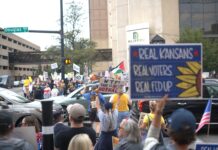
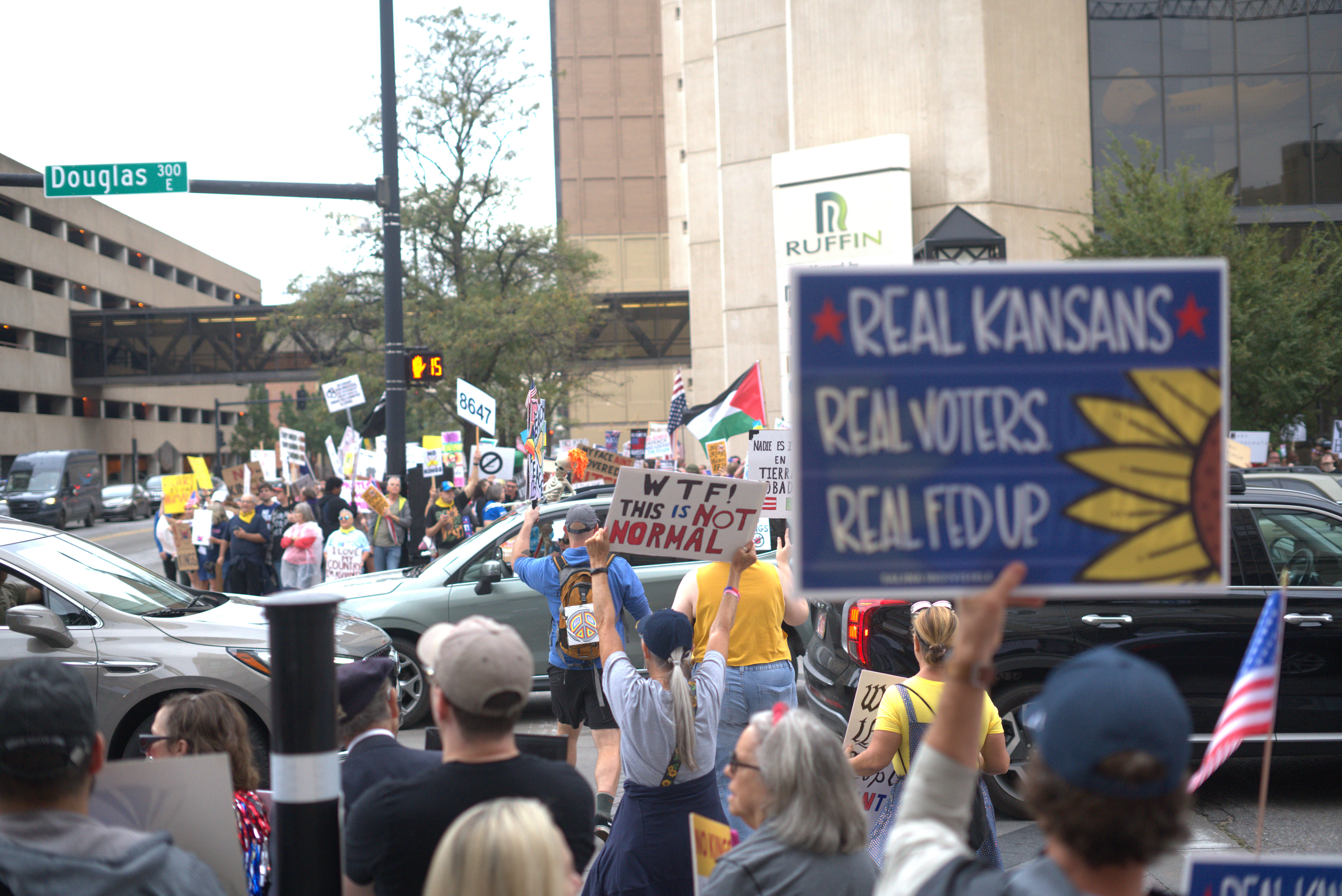
The march moved toward the Ruffin Center. By the time we arrived, the crowd had swelled across all four corners of the intersection. Whenever traffic cleared, people surged forward to cross in waves, their voices echoing off the buildings downtown. The air smelled like cold pavement and fresh marker ink. Signs bobbed above the crowd, some messy, some carefully painted, some sarcastic or humorous, some very serious.
The police presence was impossible to ignore. Officers on bicycles leaned against their handlebars as motorcycle units and patrol cars drove past. A few figures in tactical vests with SWAT insignias stood on a balcony just out of sight, scanning the crowd through binoculars. You could feel their eyes on you even if you didn’t look directly at them. But despite the security, there was no violence, no aggression from the protesters. Just voices. Just people.
As I moved through the crowd, I met people from all different kinds of backgrounds. Some were students around my age, others were older; veterans, retired teachers, parents with strollers, couples’ side by side holding hands. The diversity of the crowd was striking. There were rainbow pride flags, Palestinian flags raised high up in the air next to American, Canadian, and Ukrainian flags. Older people in wheelchairs and teenagers with dyed hair stood shoulder to shoulder. It wasn’t a crowd made up of one political group, one identity, or one generation. It was everyone.
Everyone had a slightly different reason for showing up, but their frustrations overlapped into one shared message: they were tired and wanted change. They wanted accountability. They wanted transparency. But most importantly, they wanted to be heard. Directly in front of the Ruffin Center, a guitarist began to play a familiar tune: “This Land is Your Land” by Woody Guthrie. People gathered around him, not just listening, but singing. Dozens of voices carried the song into the wind, surrounding the sound of traffic and the buzz of police radios. For a moment, everything else faded into a sort of tranquility.
As I walked through the crowd, I asked people why they came. Their answers were layered, personal, and often emotional. One lady spoke of her father’s experience fighting fascism in World War 2, and how she’s now fighting against fascism, this time without guns, but with advocacy. Others talked about the ongoing erosion of civil rights, the modern propaganda machine, and how scapegoating can normalize hate to consolidate power, and their fear of what a third Trump term, which is unconstitutional but has been hinted at by the current administration, might bring. Economic frustration was another theme I heard time after time. Several people voiced anger at how the wealthy oligarchs seemed to operate above the law, using lobbying to buy Congress, and leaving ordinary people to shoulder the burden. Their solution was simple: close the tax loopholes, make the ultra-wealthy pay their fair share, and take power back from those who have used it for personal benefit. One speaker at the Ruffin Center spoke passionately about resisting authoritarianism, emphasizing that “America has no king”, and calling for people to stand up together “to reject corruption and abuse of power.”
Even though the event was fueled by frustration and mistrust, it never boiled over. There was no violence, no destruction, just steady chanting, conversations, singing, and speeches that came one after another from people brave enough to speak up. By the end of the day, the initial moment of hostility I’d heard stepping out of the car felt distant. It was still there, lodged in my memory, but it was drowned out by the louder, more powerful sound of hundreds of people chanting together.
That’s what I’ll remember: the signs, the chants, the songs, the unity, and the voices of strangers who refused to stay quiet, all under one banner:
No More Kings.